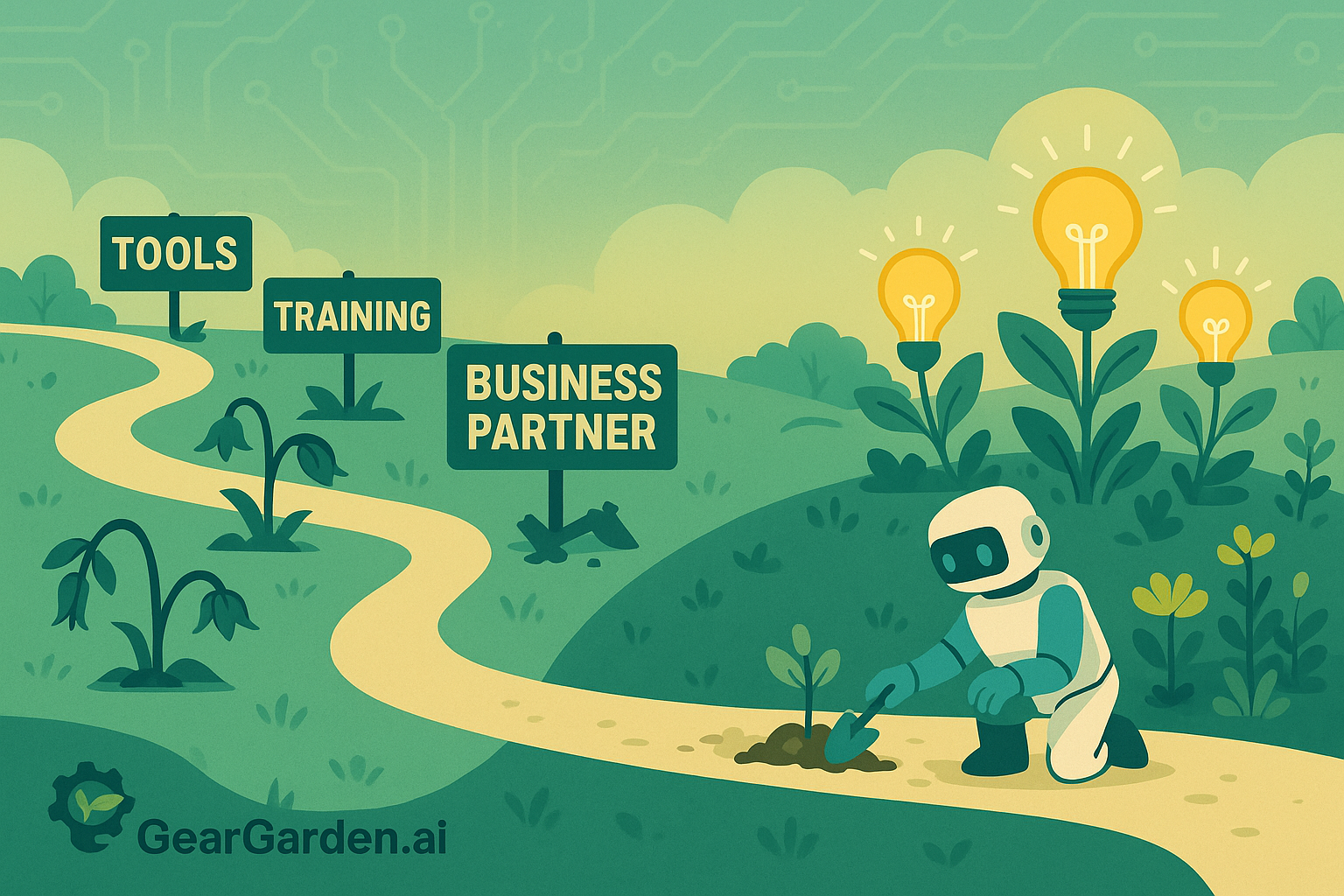
The pressure to “do something with AI” is at an all-time high. Executives feel it. Boards demand it. Customers expect it. But when it’s time to move from excitement to execution, most companies stall out.
It’s not for lack of ambition. It’s because they take the wrong first steps.
The statistics are sobering: the share of businesses scrapping most of their AI initiatives increased to 42% this year, up from 17% last year. A staggering 85% of AI projects fail to deliver meaningful business value. The gap between AI promise and reality has never been wider, and it’s costing organizations millions in wasted investment and lost competitive advantage.
Here’s why the most common approaches fail—and what actually works instead.
❌ Mistake #1: Buying AI Software Alone Won’t Save You
Many companies rush to purchase AI tools, thinking a chatbot license or multi-SaaS orchestration tool will magically transform their business. This procurement-first mentality treats AI like any other software purchase, but AI requires fundamentally different implementation approaches.
The Reality Check: One AI expert reports that retail off-the-shelf AI programs tend to have lower adoption rates and efficiency gains than custom-built enterprise AI tools. The reasons for AI project failure run deeper than technology selection: poor data hygiene and governance, lack of proper AI operations, insufficient internal infrastructure, and most critically, inadequate organizational buy-in.
Why This Fails: You can’t outsource your AI strategy to a tech vendor. Technology without context won’t deliver value. Most organizations have yet to see bottom-line impact from generative AI use—precisely because they’re treating AI as a software purchase rather than a strategic culture and skill transformation.
Without proper change management, data preparation, and workflow redesign, even the most sophisticated AI tools become expensive digital dust collectors. The technology might be capable, but the organization isn’t prepared to leverage it effectively.
Real Example: A Fortune 500 retailer spent $2M on an AI-powered inventory system but saw no improvement in stock optimization because they never addressed the underlying data quality issues or trained staff on new workflows. The system had all the capabilities but none of the context. After six months of poor performance, they reverted to manual processes, effectively writing off their entire investment.
❌ Mistake #2: Training Without Systems Misses the Mark
Upskilling is vital, but education alone can’t replace execution. Leaders often assume employees can pivot into AI engineering roles quickly through training programs, while no operational AI agents or workflows actually get built. This creates a dangerous gap between theoretical knowledge and practical application.
The Human Challenge: Trust is critical for AI adoption because if employees don’t trust a concept or a tool, not only will they fail to embrace it—they’ll actively work against it. When training happens in isolation from real day-to-day work, employees question whether the skills they’re learning have any practical value.
Why This Stalls: Education builds readiness, but working examples build momentum. Theoretical knowledge without hands-on experience creates skepticism rather than confidence. Employees need to see AI tools solving real problems in their daily work environment, not just in training scenarios.
Without functioning systems to practice on, training becomes an academic exercise that fails to translate into business value. Teams return to their desks with new knowledge but no way to apply it, leading to frustration and eventual abandonment of AI initiatives.
Real Example: A healthcare organization spent 6 months training doctors on AI diagnostic tools but never deployed any functional systems. When they finally tried to implement, the enthusiasm had faded and staff questioned whether the training was just theoretical busywork. The delay between learning and application broke the momentum, and adoption rates remained below 15% even after full deployment.
❌ Mistake #3: Consultants Alone Leave You Stranded
Traditional consultants can be valuable for diagnosis and strategy development, but they rarely deliver production-ready AI systems. When they leave, so does critical knowledge—and let’s be honest, did they ever really understand your unique business challenges and operational constraints?
The Knowledge Transfer Problem: Most customers that move forward will almost certainly choose a trusted services partner, if not a packaged AI solution. But while that may mitigate some risks, customers still need to own their own project outcomes. The consulting model creates dependency rather than capability, leaving organizations vulnerable when external support ends.
Why This Disappoints: Consultants might show the way, but they don’t walk it with you. They lack the iterative improvement and ongoing ownership needed for successful agent adoption. Poor data quality, inadequate risk controls, escalating costs, or unclear business value doom projects when there’s no long-term support structure.
The traditional consulting engagement model—diagnose, recommend, and exit—fundamentally conflicts with AI agent adoption. AI systems need continuous refinement, performance monitoring, and adaptation to changing business needs. Without ongoing partnership, even well-designed AI strategies fail in execution.
Real Example: A manufacturing company paid consultants $500K for an AI maintenance prediction strategy. The 200-page report gathered dust while equipment continued failing because no one knew how to actually build or deploy the recommended systems. The strategy was sound, but the implementation roadmap was theoretical rather than practical, leaving the internal team unable to execute.
✅ What Actually Works: Find an AI Business Partner
To truly accelerate your AI journey, you need an AI-native partner that co-designs, builds, and scales with you. More than a vendor or advisor, this partner is invested in your long-term outcomes—not just billable hours or short-term deliverables.
The Success Pattern: 92% of executives expect to boost spending on AI in the next three years, with 55% expecting investments to increase by at least 10% from current levels. But smart organizations are shifting from buying tools to building capabilities. They’re investing in partnerships that deliver sustainable competitive advantage rather than one-time implementations.
The most successful AI transformations happen when organizations work with partners who understand that AI isn’t just a technology upgrade—it’s a fundamental shift in how work gets done. These partnerships focus on capability building, not just solution delivery.
A Real AI Business Partner Will:
🎯 Design High-Impact Use Cases Aligned to Your Strategy
Not generic AI applications, but solutions that directly address your specific operational challenges and strategic goals. Sales and marketing accounts for 28% of the total potential economic value from generative AI, followed by software engineering at 25%—successful partners focus on these high-value areas first.
The best partners conduct thorough discovery to understand your unique workflows, pain points, and success metrics. They don’t apply cookie-cutter solutions but instead craft AI agents that fit seamlessly into your existing operations while driving measurable improvement.
🚀 Deploy Custom AI Agents Into Your Actual Environment
Impactful agents are co-designed by end users, management, and leadership to ensure adoption and effectiveness. Successful organizations have made efforts to prioritize and customize use cases, understanding that decision-makers who chase every AI opportunity are likely to have more projects fail.
Real deployment means working within your security requirements, integrating with your existing systems, and building agents that your teams actually want to use. This requires deep technical expertise combined with change management skills—a combination rarely found in traditional consulting firms.
📈 Train Your Teams and Optimize for Long-Term Impact
Building internal capabilities while continuously improving system performance. The goal isn’t just to deliver working AI systems, but to transfer knowledge that enables your teams to maintain, improve, and expand these capabilities over time.
This includes establishing feedback loops, performance monitoring, and optimization processes that ensure your AI investment continues delivering value long after initial deployment. Your team should feel empowered to make adjustments and improvements, not dependent on external support for every change.
🔄 Provide Ongoing Support and Iteration
AI systems require continuous refinement based on real-world performance and changing business needs. The best partners establish long-term relationships focused on sustained success rather than project completion. They help you adapt to new use cases, scale successful implementations, and troubleshoot challenges as they arise.
The Bottom Line: Start Right, Scale Smart
AI agents can transform your operations, but only if you start with the right foundation. Buying tools, training alone, or relying solely on consultants might check boxes—but they won’t deliver the business impact that your organization needs.
The companies that succeed treat AI implementation as a partnership, not a procurement exercise. They work with specialists who understand that sustainable AI success requires:
- Strategic alignment between AI capabilities and business objectives
- Hands-on implementation that addresses real operational and behavioral challenges
- Knowledge transfer that builds lasting internal capabilities
- Ongoing optimization that improves results over time
Success in AI isn’t about having the most advanced tools—it’s about having the right approach and the right partner to guide you through the inevitable challenges of organizational change.
Your Next Move
If you want real results, find an AI business partner who’s committed to your success for the long haul—from first use case to scaled transformation. Look for partners who can demonstrate previous success with organizations similar to yours, who understand your industry’s unique challenges, and who are willing to tie their success to your measurable outcomes.
The question isn’t whether AI will reshape your industry. It’s whether you’ll lead that transformation or be disrupted by competitors who started with the right approach.Need help figuring out your next move? Schedule a free consultation to learn more.


