Every day, your team sits down at their computers with access to more knowledge and insight than the greatest minds in history ever dreamed of. They can tap into the collective wisdom of thousands of business leaders, researchers, and innovators with a single prompt. But unlike the online experience you’ve known for decades that retrieves information, employees can now access synthesized insight and analysis in an organized and easy-to-consume format. This is a powerful upgrade that should boost the impact of every employee, manager, and leader.
Suddenly, everyone at work has a coach, confidant, or collaborator for every assignment or project they ever work on. If we consider how work quality improves from collaboration, then imagine how much each employees’ work can benefit from the availability of LLMs like ChatGPT, Claude, or Gemini!
But right now, most employees are leaving enormous value on the table simply because no one taught them how to unlock what’s already at their fingertips. They were never shown when to ask AI questions, or what types of questions can unlock the most value.
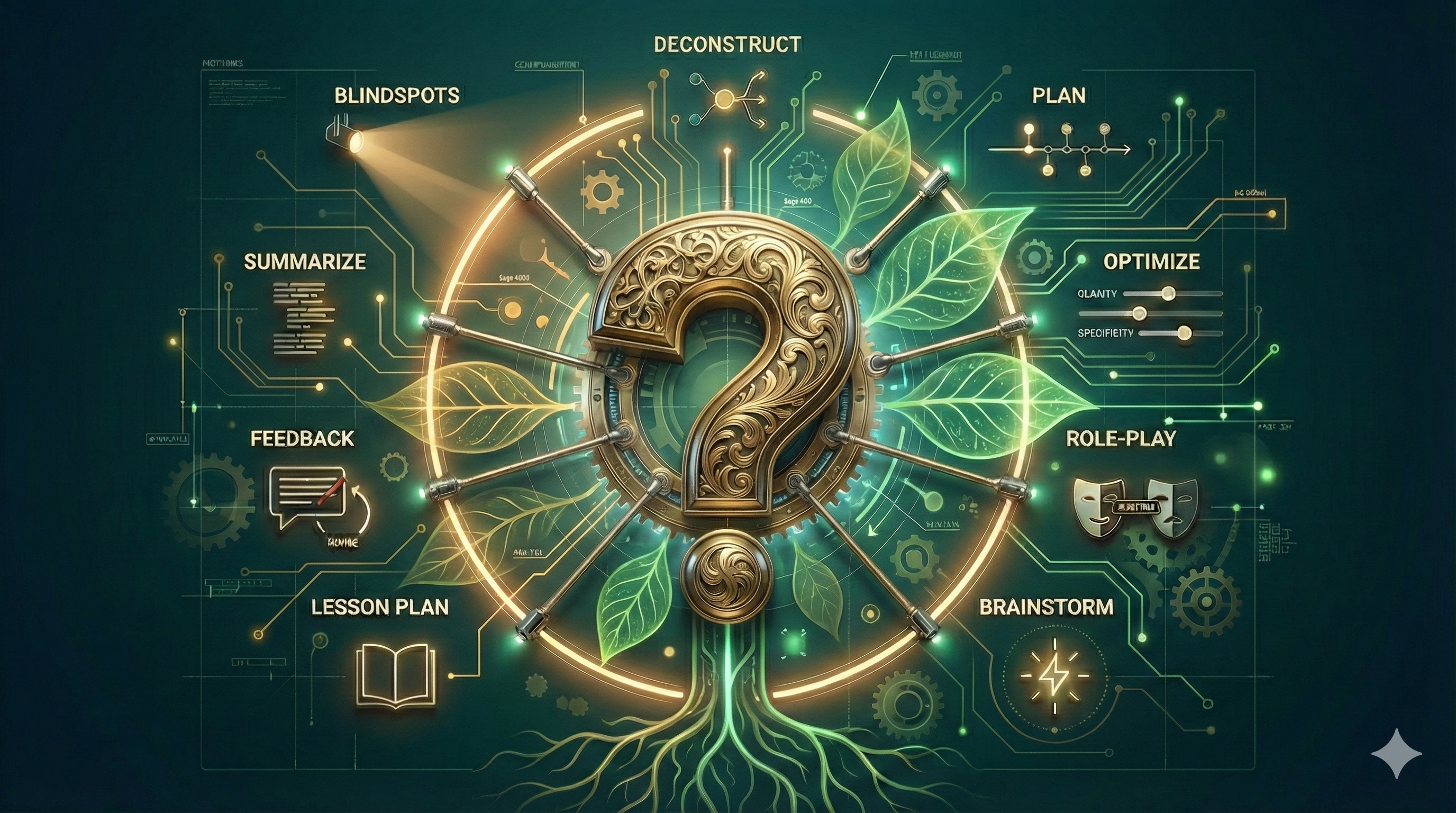
So I collected some of the most useful question types I could find to help employees make better use of the LLMs they’re already using daily:
1. “What am I not seeing here?” – Expose Your Blindspots
Why It Works: When you’re close to a problem, you develop blind spots. Your brain fills in gaps with assumptions, and teams often reinforce each other’s biases. This question forces the AI to actively look for what you’re not seeing—the assumptions you haven’t questioned, the data you’ve ignored, the perspectives you’ve missed.
When to Use: When everyone agrees too quickly (alarm bell), after getting unexpectedly good news, before making major decisions, or when your gut says something doesn’t add up.
2. “Break this down for me?” – Deconstruct Complex Problems
Why It Works: Complex problems feel overwhelming because your brain tries to process everything simultaneously. This question systematically untangles interconnected issues, revealing root causes versus symptoms. It’s like having someone organize a messy closet—suddenly you can see what you’re actually dealing with.
When to Use: When you feel paralyzed by complexity, when quick fixes aren’t working, when multiple problems seem to be hitting at once, or when your team keeps jumping between different solutions.
3. “What steps would you take to [project description]?” – Project Planning
Why It Works: Project planning requires you to think sequentially while considering dependencies, resources, and risks simultaneously. Most people either get lost in details or stay too high-level. This question creates a structured framework that accounts for the real-world messiness of coordinating people, timelines, and deliverables.
When to Use: When embarking on a new project, when coordinating multiple departments, when you have an aggressive timeline, or when stakeholders keep asking “what’s the plan?”
5. “How can this message be fine-tuned?” – Strengthen Communication
Why It Works: When you’re too close to a message, you can’t see how others will receive it. Managers and leaders especially can benefit from extra counsel when delivering sensitive or important messages to their teams. This question provides an outside perspective on tone, clarity, and potential emotional reactions. It’s like having a communication coach review your draft.
When to Use: Before difficult conversations, when announcing changes that affect people’s lives, when you need buy-in from skeptical audiences, or when your first draft feels off but you can’t pinpoint why.
6. “What would [Successful Professional] recommend?” – Role Playing
Why It Works: Successful people have developed mental models and frameworks through experience. This question taps into proven approaches and decision-making patterns without needing direct access to these leaders. It’s like having a mentor who’s already navigated your challenge.
When to Use: When facing decisions outside your experience, when you feel like you’re reinventing the wheel, when you need a different perspective on strategy, or when your usual approaches aren’t sufficient. This approach can help balance your weaknesses. For example, invoke Steve Jobs when you need to inspire the room. Or call on Warren Buffett to make smarter business bets.
7. “Can you brainstorm 15 ideas for [concept]?” – Quick Brainstorming
Why It Works: Your brain follows familiar patterns, especially under pressure. When you brainstorm alone or with the same team, you get variations of existing ideas. This question generates volume and diversity rapidly, combining patterns from different contexts to create unexpected connections.
When to Use: When your creative process feels stale, when traditional approaches aren’t working, when you need fresh perspectives quickly, or when preparing for brainstorming sessions with your team.
8. “What do I need to learn to solve [new problem] as a [title]?” – Build Lesson Plans
Why It Works: When facing new challenges, most people either dive in unprepared or get overwhelmed by everything they don’t know. This question creates a structured learning path from your current knowledge to the competencies you need, breaking intimidating skill or knowledge gaps into manageable steps.
When to Use: When taking on new responsibilities, when your industry is changing rapidly, when facing challenges outside your expertise, or when you need to skill up quickly for new opportunities.
9. “Analyze all our past interactions and suggest how I could improve my questions to get more valuable outputs” – Strengthen Prompts
Why It Works: Most people never think about improving their questioning skills. They just accept whatever responses they get. This question turns the AI into a coach for better collaboration, helping you understand how to frame requests for maximum value.
When to Use: When AI responses feel generic, when you want to get more value from your AI interactions, when training others on AI collaboration, or when you feel like you’re not maximizing the technology’s potential.
For questions on how to upskill your workforce on the most value-adding questions, schedule a consultation below.


